Thursday, April 11, 2013

The Blessing of Balance

My 4 year old gave me the gift of perspective today. He seemed to make a point throughout the day to remind me of not only the challenges of parenting in general, and the added challenge of raising a special needs child, but also reminded me of how much joy there is in being his mother.

Too often parents are quick to forget this balance when faced with day to day stresses of being so responsible for someone else’s well being. I frequently get caught up in negative emotions and react to situations I ought to think through more carefully. The gift of perspective however makes me realize how true it is that every action indeed has an equal and opposite counterpart. For every time my children bring me to anger, for every tear, for every feeling of resentment, there are just as many if not more moments to be grateful that I have the privilege of mothering them.

As parents, our responsibilities are so great, yet our blessing of creating life and guiding it through maturity is equally great. I am inspired to try a little harder and think a little deeper every time I deal with a tantrum or a mess, or anything more jolting. I am inspired to remember the treasures each day will inevitably hold, even if only long enough to temper my reactions.

Today’s gifts included a walk up and down the street, hand in hand with my beautiful little boy, as I watched him look at everything; and watching him slip into peaceful sleep in my lap, concentrating on every note of the lullabies I sang him. For these gifts I am eternally grateful, and for the gift of tomorrow to experience more examples of perspective and balance.

- Adrienne

Wednesday, March 20, 2013

Picture This

Most in the Autism universe know the value of picture schedules and visual communication. So many kids on the spectrum feel more in control when they know what is going on. Kids with speech delays or other communication challenges also benefit from having other means of telling us what they need or want.

My first experience with using visuals came before I knew anything about Autism. When Sam was a preschooler, he could never keep his toys picked up. I know that seems like a typical behavior. Most kids are messy. I struggled with teaching him how to pick up after himself though because he had many toys, and lots of containers to put them in. He also got really overwhelmed when all the toys were out. So I decided to use pictures to help him stay organized. I took pictures of his clean, organized room so he would know what a "clean room" looked like. Then I took pictures of each toy bin with the toys that went there, and attached them to each container. Each day when it was time to clean up, I sat in the room with him and helped him pick up one type of toy at a time and put it where it belonged.

It wasn't a fool proof system to be sure, but it did give me a lot of insight into what would help Sam in general. I began using visuals for chores, reward systems, and even meal time.

Liam learned to use a picture schedule in Early Intervention, in the structured play class. It seemed to help him a lot. Since at that point his verbal skills were just starting to develop, I decided to implement our own picture schedule at home. We used it to organize his day a little at first and to help him understand bath time and bedtime. I used Velcro on the corner of a large whiteboard we already had, and laminated pictures of him doing the activities on the schedule. It took us a while to get the hang of it. But now we use it every day to remind him what the day's plans are (like school, therapy, etc.)


We use magnets to keep the bag of pictures and "Finished" envelope handy. We also found though that when it was time to run errands in the car, simply showing him "car ride" was not enough information. He has developed enough where the details matter more. He needs to know exactly where we are going, and he may very well have distinct preferences about them too. So after a lot of research and trial & error, I created a little schedule for the car. I laminated an index card and put Velcro on both sides (4 spaces). I made mini versions of any place we might go in the car, like school, grocery shopping, the park, etc. I keep the card in my purse, and the pictures in the car.


Liam has even graduated to requesting some places, first with the picture, then just by name. I suspect that eventually we won't need the pictures; we will be able to tell him we are going to the store or the gas station, and he will know exactly what we mean. Now if we could only get him to agree with where we are going . . .

- Adrienne

Sunday, March 10, 2013

Thinking Errors: How to Jump in the Deep End of Aspergers Emotions

I've been doing a lot of soul searching the past few weeks, and lots of research, and phone calls, and crying, and more phone calls . . .

This school year we attempted to put Sam back in public school, to allow me to find some part time work and contribute to family finances. No such luck, but inevitably better since I am needed at home right now. Sam did so well for about a month, and then started to deteriorate, both emotionally and academically - this is a first. Being a tween involves so much more social pressure to fit in, and Sam just doesn't. He wants to, but it lasts only so long before kids don't want to play by his rules, or always hear his ideas. And kids can be mean, so friends become enemies with little advanced notice.

By Halloween, it was clear we needed to find an alternative, even if temporarily. After Thanksgiving, and a visit to Vancouver to spend time with his grandmother, we registered Sam in a day treatment program. We hoped that the limited stay in a less stressful environment would allow him to learn, or practice, emerging social skills, and work on his emotional development. After 9 weeks, we saw very little progress, mostly sporadic, and little transfer of skills to the home environment.

Every one of his therapists, and even school administration, recommended a change of placement. But rules are rules, and everything has to be documented and supported by data. And there wasn't enough of either as far as the school district was concerned. So back to school he went, so he could fail again and the district could take data on it. What a completely illogical way of treating special-needs students. And how naive I was, even after 6 years of never getting the resources he needed, to agree to this.

After just one month, and many absences, and suicidal meltdowns at home, we pulled him out permanently. But the meltdowns have yet to stop. They get worse with every one, and we are keeping the crisis line number handy, just in case. It should never have come to this. And I keep asking myself why, and how can I help him? Where do I even begin?

I found an article, inspiring this post I might add, that I will be rereading and sharing ad nauseam, because it explains the errors in thinking that I believe are the entire base to all of Sam's meltdowns. I don't know if understanding them will help me help him, but I hope so.

My Aspergers Child: Helping Aspergers Children Eliminate “Thinking Errors"

In brief, there are five thinking patterns discussed in the article: over-generalizing, minimizing/maximizing, emotional reasoning, fortune telling, and all-or-nothing thinking.

  • Over-generalizing is when the child uses one event to assume future outcomes. For example, Sam believes that because his brother Liam (4) refuses to hug him, that Liam must not love him.
  • Minimizing or maximizing is essentially "making a mountain out of a molehill" and vice versa. For example, Sam frequently believes he has no talent because of the things he can't do, and minimizes his artistic abilities and skill at building elaborate structures in Minecraft. This also happens with blowing mistakes out of proportion and thinking about the worst possible outcome. We hear this a lot too, like when Sam goes out to find neighbors to play with, and the first one isn't home. He then says that the other kids probably won't or can't play either, and he will be bored all day.
  • Emotional reasoning is the confusion between feelings and reality. For example, when Sam plays with his brother, Liam hits him sometimes. Sam feels hurt and angry, and assumes Liam is doing it deliberately.
  • Fortune telling is making predictions or assumptions with no supporting evidence. Frequently Sam will have a meltdown in the middle or towards the end of the day. If he has been enjoying privileges, he will often say "I guess this means I won't get ___ today" (like to play the iPad, or a trip to the store) when I have made no comments about what he can or can't do in relation to his behavior.
  • Finally, All-or-nothing thinking is, well, thinking in terms of always and never, and is related to minimizing and maximizing - this is the extreme version. So when Sam doesn't get to play with a particular friend, he "never gets to do what he wants," Or when he can't have ice cream, he "never gets anything" and we are "the worst parents in the world."
In many cases, we see all five of these combined into the ultimate meltdown, on top of sensory over-exposure, and anxiety, and it results in Sam believing the only way to stop feeling this way is to not be alive. It's very scary. And yet, I still believe there is a solution out there, there is help, we just haven't found it yet. I hope that's not an error in MY thinking ;)

- Adrienne

Tuesday, March 5, 2013

Pumpkin Muffins

Not surprisingly, I found, while going through my pictures, that I had virtually nothing from October 2011 when I started changing diets, till March of 2012, when I backed off. I must have been too busy! I did find my first batch of gluten and dairy free Pumpkin Muffins, a la Silvana Nardone (check the Books page for info on her cookbook).


Notice they were half gone by the time I took the picture. Still a favorite breakfast treat, when I have time to make them.

- Adrienne

There and Back Again

Making dietary changes for one's self is comparatively easier than changing someone else's diet, or a whole household. When I initially began my research on diet changes affecting Autism, it was inspired by some information my sister shared with me about the effects of yeast and sugars on the brain. I am a skeptic, so I tend to be very thorough in investigating any health claims, especially when considering my kids.

After doing heavy internet research (including peer-reviewed articles; I will post some titles in my Books page), and lots of library books, I decided I had nothing to lose by starting with Liam. Even though his doctor was not supportive, I knew it wouldn't hurt him since his diet was so limited already.

I know, it sounds like taking away ingredients would further limit him, but I started by replacing the foods he ate with gluten free versions, or introducing new snacks. So Teddy Grahams became Annie's Snicker Doodle Bunnies, Kix became EnviroKids Gorilla Munch, etc. It took a few weeks to inventory what needed to go, and introduce a few new snacks. Within two weeks however, we were seeing a change.

Liam wasn't eating more per se, and was still having tantrum issues, but his focus increased, his attention span lengthened, and sitting for a few minutes became 10 minutes or more. Even his teachers at Early Intervention noticed a difference in his participation.

And then there were words.


Beautiful, plentiful, yet repetitive. But I heard him finally say "Mommy" with regularity, and he learned his brother's name, and Grandma, and so many more. Most of his speech till now was more sounds with little combining, and mostly random vocal stimming. None of it was functional, and he did not point or gesture. And yet, here he was, as if he had known how to all along.

I was so surprised, and so was Daddy. Daddy had been gone for several weeks, out of town for work. We decided to make the 4 hour trip to spend a night with him, and he couldn't believe the difference. In hindsight, it could have also been because he hadn't seen his son for weeks, but I think it was both. We did notice increased trouble sleeping, though, and more harmful tantrums. So I decided dairy was the next victim.

And out it went. This was more difficult, as some of the gluten-free favorites had to be replaced yet again. And most of Liam's calories were coming from the dairy-based Pediasure, so we had to look for other ways to increase calories (I looked high and low for protein powder, and only found an expensive rice based one to try for a while).

Lo and behold, no more head banging, less screaming, and less night wakings. By Thanksgiving, we thought we were in the home stretch. It was like opening a door that had been nailed shut for almost 3 years. I was so excited, and at that point began changing some foods the whole family ate.

December unfortunately saw a return of some of the tantrums and head banging. I had read in several books that children with dairy sensitivities often reacted similarly to soy once dairy was taken away. I was emailing a TACA mentor at the time, and asked her thoughts on this. She too believed this was a strong possibility. After trying to eliminate any other possibilities, I began removing soy as much as possible. And here again, tantrums and self-harm began to disappear.

Now, I have read dozens of snippets and articles on both sides of the diet intervention debate. There is still mainly anecdotal evidence for its effectiveness, as for so many other treatments parents try. I mean, we desperately want our children to be happy and functional. Who wouldn't try just about anything? Here are my two cents, after using diet briefly (6 months). At least for my children, dietary intervention has worked just as other therapies: the kids thrive on the changes, and make leaps and bounds in development, and then plateau. This is when we stopped, conveniently the same time as I was about to lose my mind over the extra time, effort, and money. And I call it successful because we saw no loss of progress. Just as with Occupational and Speech Therapy, Liam does well, then needs a break.

Now to just get the motivation to try another round :)

- Adrienne

Thursday, June 14, 2012

Ordered Chaos

I have been feeling over the past few months that I've so badly neglected this blog and all my hopes and dreams for it that maybe I should abandon the project altogether. However, I realize that the point was to document my adventures in raising two vastly different yet somehow similar children with Autism and sensory issues and a host of other things. Life with them, on top of other stressors, is by it's very nature, extremely complex, and defies any efforts I make to organize it or schedule it or make sense of it. And yet I try any way, because that is MY very nature - to try to order and organize every bit of my life (and everyone else's, to their chagrin). That's my bit of neurosis.

This is why my blog gets neglected. Because some months (or days, weeks, etc.) are more chaotic, while others are a bit more inclined to order. I suppose the higher chaos times I end up with way more to write about when I get the chance though. Far more to think about, that's for sure. It'll end well, assuming an end.

To sum up the chaos that will eventually make it into individual posts:
- our foray into the world of diet restrictions (i.e. gluten-free, dairy-free, and then soy-free) for Liam, then Sam, then me, in various forms
- new GFCF experiences with cooking and baking (woo-hoo!!!)
- occupational therapy and sensory integration
- speech therapy
- behavioral therapy
- feeding therapy
- structured play
- homeschooling, structured play at home
- an end to early intervention, changing insurance, and revamping school/work for everyone
- lots of research (I already added a ton of books and reviews to the books page and websites)
- AND new friends and resources
- (not to mention regular things like housework, fall/winter holidays, family, the Superbowl, etc.)

I know, it's a lot, but I meant it when I said chaos. No order, not even a little. No wonder I was too busy to post anything :)

- Adrienne

Thursday, October 13, 2011

Between a Rock and a Hard Place


I have spent the last few weeks entrenched in my newest research project (research is kind of a hobby of mine) – to find more ways to help my kids be successful, not overlooking anything I might have been reluctant about. This was inspired by conversations with one of my sisters and information she shared with me, for my own perusal, nothing more. My sister is a vegetarian, and has made many diet and lifestyle changes for health reasons. She recently began cutting out foods that contain sugar, or ingredients that can become sugars or yeast in the gut. I had never heard of such a diet, but I have heard of other dietary interventions for a variety of issues, some that she and I share. She also wanted me to read the research behind the diet, as it was shown to help with Autism.

After looking through some of the links and articles, it occurred to me that diet and nutrition might be a puzzle piece I was missing, considering that Liam is not growing well, eating hardly anything, and sleeping very poorly. I’m well aware of how diet affects physical and mental functioning, if only from personal experience. So I cross-linked to other sites, searched out books at the library, and hunkered down (in the precious little time I have to myself each day) to gather information.

I am a skeptic at heart. I need to read or see the science behind things. I usually scoff at anything that has no proof, or at least nothing tangible to back it up. So this is the purpose of my research. What I have found however, is way more than I expected, and almost shocking that I haven’t heard of much of it before. There’s been tons of research done in the last 15 years that supports dietary interventions and nutrition assessments for children with Autism Spectrum Disorders. It makes sense too, that if diet and nutrition are so important for normal growth and physical and mental functioning, this should be a crucial piece for treating children with ASDs. These children (mine for example, but there are hundreds of thousands more) regularly have problems with cognitive functions and communication, GI issues, feeding difficulties, sensory processing problems, and fine and gross motor issues. So why isn’t this addressed by our pediatricians?

Well, Judy Converse, MPH, RD, LD explains it quite well in her book “Special-Needs Kids Eat Right.” (2009, Penguin Group, New York) It’s a combination of history, holes, and controversy.
  • History: Unfortunately, some remnants remain of the now defunct theory that Autism is caused by cold, unloving mothers. It was a terrible idea to begin with, but we are still having trouble ridding the world of this.
  • Holes: Most doctors don’t receive any training in nutrition during their education. Why? Because of specialization. The medical field now has specialists for every system in the body, but all separately. There is no whole body practice. And, pharmaceutical companies are great marketers, so doctors are encouraged to push prescriptions, and treat symptoms, instead of getting to the root of the problem. I have this complaint all the time, that doctors don’t treat patients, they treat symptoms.
  • Controversy: Finally, there’s the sacred cow of vaccines. Most don’t know the whole story, or the science that got misconstrued, so the safety of vaccines is still in hot debate. But the truth is, vaccines are safe (in my opinion), except for a subset of children who may be predisposed to react to a clustered viral exposure. I don’t feel my children were adversely affected by vaccines, but there are children out there who were.
So all this means that traditional doctors are reluctant to venture into treatments that aren’t mainstream, especially in fields of knowledge they are unfamiliar with, like nutrition (that is usually the domain of licensed dietitians and nutritionists).

On Tuesday, at the boys’ physicals, I too found this out the hard way. But I was prepared with the above knowledge, and knew which questions to ask. The pediatrician, as expected, was reluctant to offer any information about dietary interventions or the like. But she recognized my concerns about Liam’s poor growth and nutrition, and referred me to a nutrition clinic that also has a GI department. AND it’s covered by our insurance!

I do feel kind of stuck though, between the immovable rock of traditional medicine, and the hard place of going to the other extreme, territory I’m uncomfortable with unless I can read the science. It’s a tough place to be when I just want my kids to be healthy, and be the best they can be, whatever that turns out to be. This is a place many parents of ASD kids before me have been, and more after will be. But I hope it will be easier for them as time goes on.

Here’s hoping for progress and open minds.
- Adrienne

Friday, September 30, 2011

Going It Alone


This week we received some bittersweet news from my husband’s employer, in the form of a change in the out-of-town job he’s been supervising. It would require he stay on the job site for 45 days or longer, instead of the one week on and one week off it’s been this month. While I’m glad he not only has a job in this economy, but is also afforded opportunities for more hours and better pay, his absence is felt very strongly at home. I’m sure other households with special kids can relate when one caregiver must be absent for long periods of time. Heck, any family with one parent who takes business trips can understand.

This reminds me of a few things. First, I sympathize with my mother even more. There was always a baby in the house, and for several of my Elementary years, my father took numerous business trips and was away a lot. There were anywhere from 4 to 6 children at the time, and my mother, amazing as she is, cannot have gotten through that unscathed. I know I wouldn't have.

I’m also reminded, as I am anytime my husband is gone, how much he does when he’s here, and how much I should appreciate his support. I know I don’t do that enough when he’s home.

That all being said, I think as parents of special kids, we understand how isolating it can be to care for them. I have read so many blogs and comments from parents that we feel so alone sometimes. The lack of resources just touches the surface. Sometimes there are family members and friends who just don’t get it, and we get tired of explaining all the time. (My cousin commented on this on Facebook recently, and it kind of inspired this post.)

I suppose if this is our lot in life, we need to be our own advocates for the support we need, and our own researchers of resources. And we need to band together to gain strength from each other. It’s a long, hard road to travel, caring for special kids and all the joy and heartache that brings with it.

- Adrienne

Sunday, September 25, 2011

Zucchini Experience


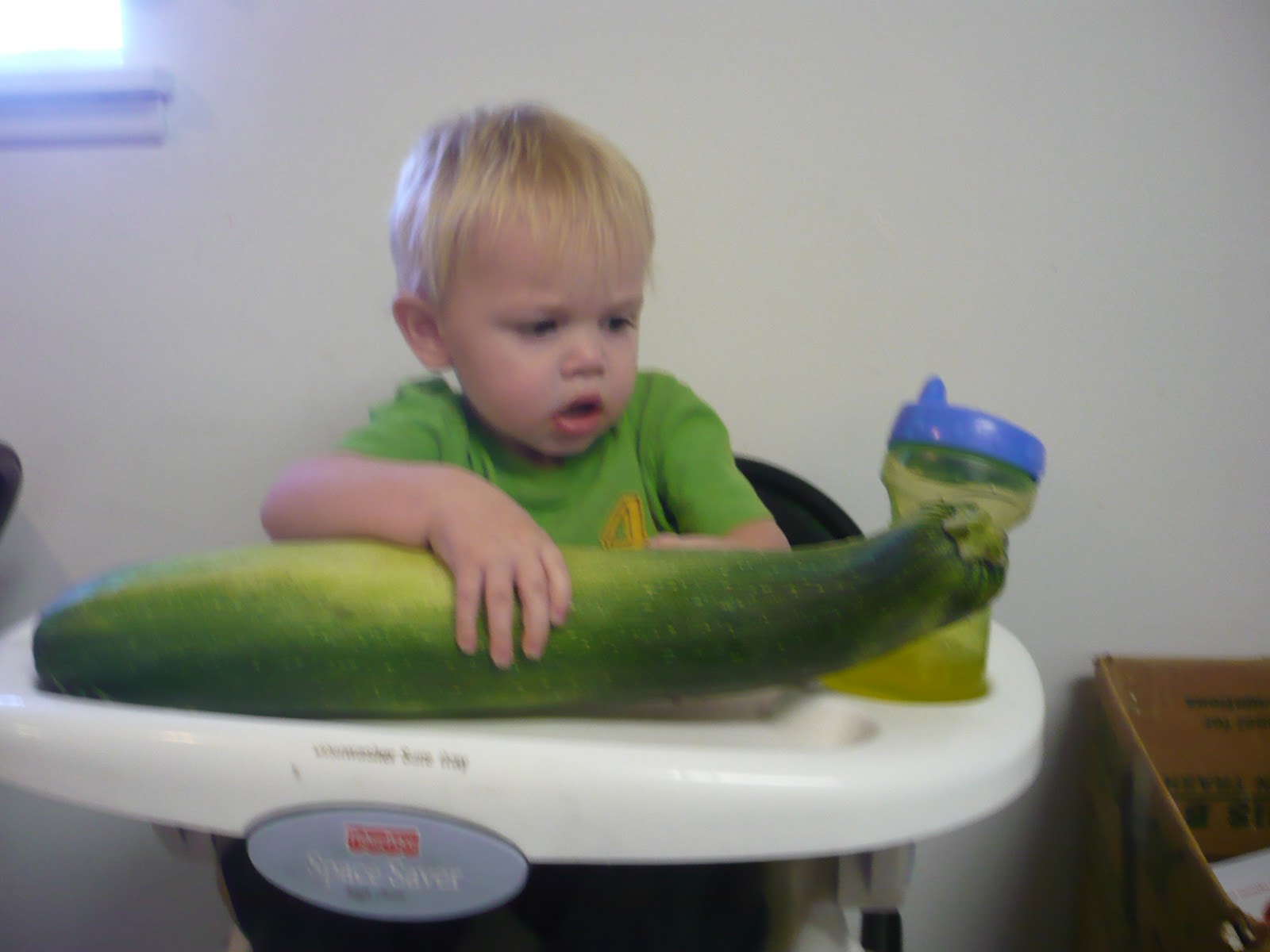
Our landlord brought us some zucchini yesterday, leftovers from his wife's garden. I hadn't pulled it out of the bag till today, so I had no idea how HUMONGOUS they were. One green, one yellow. I offered them each in turn to Liam to examine, and then to Sam. The differences in the way the boys experience them is so telling.

Liam tried to pick up the green one.

After multiple failures, he decided it was too big.

The yellow one was just right, however.

He proceeded to bang it on its end with much gusto,
because this made such lovely noise.


He also tapped it against his head.

Liam, being the sensory seeker, really enjoyed interacting with the zucchini with his whole body (as much as possible being in his high chair.) He loved touching it, feeling it, smelling it, and making noise with it. Sam however, took an entirely different approach.


The green zucchini immediately became a weapon.
And yes, the crazed look was part of his desired pose.
Sam is not one for candid photos. If he knows there's
a camera, he is posing for it.

Only when I asked him to calm down a little did he
choose to cradle the zucchini like a baby, his idea.


Note that Sam chose to interact with the zucchini in a more limited way, and use it as a tool of his imagination, rather than for its own sake. Not that either way is wrong, just different. And very directly related to how each experiences sensory issues and the Autism Spectrum.

I like observing them in the same activity sometimes, for precisely this reason: to watch how differently they experience life, and yet how similarly; and how I can share it with them. I did, after all, offer them the zucchini to play with, and took pictures. It was fun, for all of us I think.

- Adrienne

Saturday, September 24, 2011

Sensory Processing Disorder


Here's a brief overview of Sensory Processing Disorder. There are several categories that comprise the disorder. The most common, and the one my children fall under, is Sensory Modulation Disorder. This involves one or more areas of sensation, including:

  • Touch
  • Movement and Balance (Vestibular)
  • Body Position and Muscle Control (Proprioception)
  • Sight
  • Sound
  • Smell
  • Taste

The response is usually one of three:

  • Overresponsive (or avoiding)
  • Underresponsive
  • Sensory-Seeking

Let's use Sam as an example (as related to the previous post, only SOME shoes make sense,):

- Being Overresponsive to touch, he is hypersensitive to certain textures, tags in clothing, light touches, and reacts with a fight or flight response.
- Sam gets easily distracted with a lot to see, lots of people, too many toys in the store, or even cluttered classroom walls, and can't focus on his work. Bright lights make him squint and his eyes water and burn.
- Noise is a constant complaint, and a distraction. If I turn the radio up in the car, he says it's bursting his eardrums. He was afraid of the vacuum as a baby.
- Smells are always much stronger for him than anyone else, even ones no ones else notices. This can be an issue in public since he does not know the difference between rude and polite comments about people.
- Taste becomes and issue at dinner every night. I never use pepper if I want him to eat, and anything new usually remains untouched. He also doesn't like his food mixed together or touching, because the flavors mix together and taste different.

It can be challenging, navigating Sam's sensitivities, and then turning around and dealing with Liam's, which are opposite in most cases (he's a sensory-seeker in most areas). However, it's also quite interesting to learn about the science behind the disorder, and the proper sensory functioning. Makes me feel smarter knowing what I know and sharing it.

- Adrienne

only SOME shoes make sense

On Friday, I took Sam shoe shopping, and learned a thing or two about him.

Number one: he has man feet. The kid is 10 years old and wears a size 6. Kid shoes only go to a size 6. In a few months, I will no longer be able to buy the cheaper kid shoes and will have to shell out twice as much for adult shoes that he won't like as much because adult shoes come in "boring" styles. (It's true, I saw the ones at Payless for men.)

Number two: Sam's experience with Sensory Processing Disorder (SPD) extends from his hair to the tips of his toes. When picking out shoes, he has a clear preference based on the weight of the shoe as a whole and the weight of the material touching his feet, as well as how snug it is. Shoes that are too heavy, like "skater shoes", never make the list. He likes the new Airwalks that look more like old Keds I had as a kid: light canvas, with a tie so he can adjust how tight they feel, and almost no bulk to them at all.

Sam is a sensory avoider when it comes to touch, sights, sound, smells, and tastes. Everything is too scratchy, too bright, too loud, too stinky, too spicy, and has been since he was an infant. And according to my mother, I was like this too - a very sensitive baby. But in light of my new-found knowledge on SPD, I have new coping methods and a better understanding of what makes Sam tick, and why some things are "too much" for him.

And one positive of the experience - those lighter shoes cost less than the bulky skater shoes!

- Adrienne

Thursday, September 22, 2011

Lines of Communication

One of the key features of Liam's PDD-NOS diagnosis is his delayed communication development. At 2 years and 7 months, he has less words he says regularly than I can count on both hands, and most of them can only be interpreted by us. They don't even sound the same every time. He doesn't point to things, or look where we are pointing. He doesn't understand most of what we say, except for limited words, and some signs. And he does not babble or put sounds together or make noises that sound like they could be words, most of the time.

However, we have spent the last year learning to communicate with him, and learning how he communicates with us, through trial and error, and sometimes through sheer luck and happenstance.

Daddy has been away for the last 4 days for work, and was gone for 7 days a week and a half ago. Liam loves Daddy. Not just any kind of love a kid has for his Dad. No, Daddy is the favorite, preferred over all other human beings on the planet. Daddy's absence is felt by all, with a vengeance. Liam has made it clear this week especially how much he misses Daddy, and I have become aware just how deep the connection may be. It also makes me rethink the lines of communication between them.

Twice this week, Liam has led Grandma to our bedroom door, saying Dada (one of his few words), and upon being let in, climbed on the bed and lay down in Daddy's spot with his head on the pillow for a few minutes. I suppose he was breathing in the lingering scent. Then he tried to bring Daddy's clothes out into the living room with him.

Last night, Liam woke at 2:30 AM and had to be brought into bed with me. He fell back to sleep, but then woke for the day at 5:30. Upon informing my husband of this, he told me he too woke up at 2:30, very alert, and did not know why. And his alarm was set for 5:30 this morning.

I'm not usually a big believer in other-worldly things or fate or whatever. However, there does seem to be a deep connection, or bond of communication, that ties my husband to his only son. And perhaps it is indeed related to the fact that Liam has such limited powers of communication. He can't use his words to tell me how much he misses his Daddy. He can't tell his Daddy he loves him on the phone (although he can kiss the phone when I put Cliff on speaker, which he did this evening). He can't even communicate his frustration or anxiety to me in a way I can understand and soothe, except to be cranky and difficult until Daddy comes home on Monday (yes, 9/26, it's forever from now). But it means something, and it plucks at my heart strings.

- Adrienne

Wednesday, September 21, 2011

A Little Background


In my daily life, the things I find most rewarding, as well as sometimes the most frustrating, are finding every way I can to help my kids live the best lives they can. By “best” I mean getting enjoyment like all kids should, but also fulfillment and development and learning, so they can grow into happy, productive adults. 

This is a challenging task and a full time job. Not only are they 8 years apart, so at very different stages of life, but they both have Autism Spectrum Disorders and Sensory Processing Disorder. But the similarities stop there. My 10 year old has Aspergers and is very bright, has the vocabulary of an adult, reads well beyond his age level, and faster than me. He’s also a sensory avoider, and over-sensitive to just about every sensation. My 2 ½ year old has PDD-NOS, with mainly communication and developmental delays, so he barely speaks at all, and behaves more on level with an 18 month old, except for his activity level. He is also a sensory seeker in almost every area, except for feeding. He has serious food aversions because of his other sensory seeking needs. So one kid talks non-stop, and freaks out at loud noises, smells, crowds, etc. and the other talks very little and makes lots of noise and loves rough housing.

The task is also challenging because Aspergers was only in the DSM-IV (Diagnostic Statistical Manual version 4, basically the Bible for psychologists/psychiatrists) as of 1994, so research and information are still scant. PDD-NOS likewise is such a broad category and is used in so many different ways (like a temporary diagnosis, or a catchall for kids who don’t fit Autism fully) that there is not enough specific information. Sensory Processing Disorder is an even newer field of research (only the last 15 years or so has it been more fully recognized) and many doctors and professionals still don’t know much about the science behind it. So information is not easy to find, nor are resources, at least anywhere not near a rather large city (I live near Salt Lake City, which is a SMALL city) where there are plentiful research schools and other organizations.

BUT, I find the challenge rewarding not only for its results, (like when I find things that work!) but also for the journey. I am very academically inclined, and obtained a useless Bachelor’s degree in History because I loved reading and researching so much, and preferred facts and historical information to fiction or science. And I’m well-versed in using technology, being raised in a techie family (my father was a software developer for many years). I enjoy hunting down information at the library, on websites, through word of mouth, and cross-referencing everything. I have more internet bookmarks than I care to count, on every topic I can think of that might help my kids function better, or enjoy life a little more, or give me a break from it all. 

Every day is a new adventure. I don’t know which child will throw a tantrum about what, or if I’ll have a strategy up my sleeve to deal with it. And new ones pop up all the time, as the children enter new life stages (my oldest is now a tween, and acting much like a teenager with his constant attitude and defiance, and my younger is smack in the middle of terrible twos, despite being behind in a few areas).

Oh, one more thing. To top all this off, I’m a Bipolar Mommy. While I do okay most days regulating my own emotions, and have had 5 years of practice doing so, that’s still only 5 years, and as many with Bipolar Disorder know, it’s always a work in progress to hold your own. So my patience level fluctuates from day to day, and my emotions are tied inextricably to my successes and failures at helping my kids thrive. My husband is a trooper, I can tell you that much.

So bear with me as I "puzzle" through the conundrum that is raising my sweet boys to successful adulthood. And if I can share anything of value or enlighten you in anyway, or at least give you a laugh, awesome. If nothing else, this provides me an outlet, and a record of my failures and triumphs.

- Adrienne